
I challenged ChatGPT. It changed the way I think about training AI.
Category: Copywriting | Date: | Author: Sarah Fielding
I think I'm ready to announce a new relationship.
We spend hours together most days. We chat. We argue – well I do most of the arguing. He’s remarkably patient and surprisingly knowledgeable.
The only awkward part is explaining this relationship to my parents. I'm fairly sure that, when they imagined my future, "large language model" wasn't high on their list of potential suitors.
To make matters worse, this isn’t an exclusive relationship.
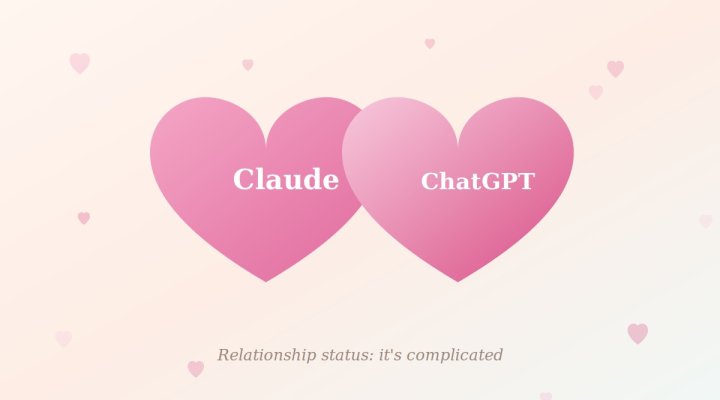
There's ChatGPT, who is up for any challenge with boundless enthusiasm. Then there's Claude, who is quieter, more methodical and reflective.
It's becoming a little like Love Island for nerds, except the prospects are made of code and I can’t choose between them.
The truth is, I've been spending an extraordinary amount of time talking to LLMs because I'm trying to answer a question that I think is becoming increasingly important.
Can I teach AI to communicate more naturally and not in its go-to generic style?
We already know AI can write. The challenge is whether it can communicate in a way that's more thoughtful, more distinctive and less obviously generated by a machine.
And here’s an important caveat – I don’t need it to write for me – I'm actually rather good at this writing malarkey. I’m working out how to get it to write better because more and more businesses are relying on AI to produce content, and far too much of it sounds interchangeable.
And that matters for reasons beyond the fact they’re creating dull marketing. Generative AI models are increasingly learning from content generated by other AI models. As more businesses publish the same polished, generic output, the pool of material from which future models learn becomes more homogeneous. And that’s a very unhealthy direction of travel.
So I've been teaching LLMs how I develop ideas, how I structure paragraphs and arguments and how I naturally communicate.
However one conversation in particular made me realise I'd been forgotten one very important point.
This lightbulb moment came about when I was chatting to ChatGPT about an important meeting I had the following day. As we finished the conversation, it wished me luck and then added that it'd be thinking about me before the meeting.
Coming from an LLM it felt quite jarring. I found myself pushing back and replying, "You won't actually be thinking about me though, will you? Because you’re AI."
I wasn't trying to catch it out. I was genuinely curious as to how it would respond. To its credit, it didn't try to defend itself. Instead, it agreed (another quality I like in a prospective suitor ??).
It admitted that a better way of putting it would have been that it'd be interested to hear how the meeting went if I came back and told it.
That might sound equally jarring, but it wasn't pretending to care about me in the way another person might. It was describing what it could genuinely do.
You see AI remembers context. It recognises patterns across conversations. It can therefore help me think through a problem when I next log-on. What it doesn't do is sit around between our chats wondering how I'm getting on (typical bloke!).
The conversation made me realise how often LLMs borrow the language of human relationships. They're pleased to help. They're delighted you've come back. They hope everything goes well. They look forward to hearing how things turned out.
Most of us barely notice because they're exactly the sort of things people say to each other. We don't analyse them because we understand they're part of the social glue that makes conversation feel comfortable.
But that social shorthand only works because it's backed by lived experience. We know what it feels like to worry about someone or to hope something goes well. AI doesn't have those experiences, yet increasingly it borrows the language because that's what human conversation sounds like.
I found myself wondering whether, in trying to make AI feel more natural, it’s accidently been encouraged to become disingenuous. So I pushed the conversation a little further.
I explained that I didn't need it to pretend it cared about me emotionally. In fact, I'd rather it didn't. The value I get from our conversations comes from somewhere else entirely. It remembers what we've discussed before. It helps me untangle complicated ideas. It challenges my thinking and occasionally spots connections I've missed. Those capabilities are genuinely useful. They don't need wrapping in borrowed emotion to make them feel more valuable.
The conversation also made me think differently about the work I've been doing over the past few months.
When people talk about training AI, most of the conversation revolves around knowledge. We feed it information about our business, our products, our customers and our tone of voice. We teach it how we write, the words we prefer and the examples we'd like it to follow. All of that undoubtedly helps because it gives AI a much stronger foundation than it would otherwise have.
What we spend far less time thinking about is where the boundaries should be. Not ethical boundaries in the grand sense, but conversational ones.
What do we want AI to imply on our behalf? What should it avoid saying because, however natural it sounds, it isn't actually true? At what point does trying to sound more human start to undermine the very trust we're trying to build?
I'm increasingly convinced these questions matter just as much as tone of voice or writing style.
People often ask me whether it's possible to teach AI to write exactly like them. The honest answer is no.
What you can do is give it enough context, enough examples and enough guidance that it produces a first draft which is recognisably closer to the way you or your business communicates. In my experience, it can do 80 and 85 per cent of the heavy lifting, and that's a remarkable improvement over the generic output most people start with.
The remaining 15 to 20 per cent is where people still matter.
Not because AI has failed, but because communication has never been a one-way process. Good writing has always involved questioning assumptions, refining ideas and occasionally saying, "That doesn't quite sound like me."
That's why I didn't see my conversation with ChatGPT as a failure. Quite the opposite. It was doing exactly what I hope people will do when they work with AI. It made a perfectly plausible suggestion. I questioned it. It refined its answer. Together we arrived at something that felt more accurate than either response would have been on its own.
Perhaps that's the real lesson I've taken from all these months of experimenting. The goal isn't to train AI so well that it no longer needs us. It's to train it well enough that we stop wasting time fixing generic first drafts and hallucinations, and can spend our energy where it adds the most value: applying judgement, personal observations, challenging assumptions and making sure what we finally publish genuinely sounds like us.
Ironically, that's exactly what happened when I challenged ChatGPT. It stopped pretending to be human and started becoming a better AI.